10 min read
Sequencing a Concrete Repair Without Locking Residents Out
Gavin Sederopoulos : Published
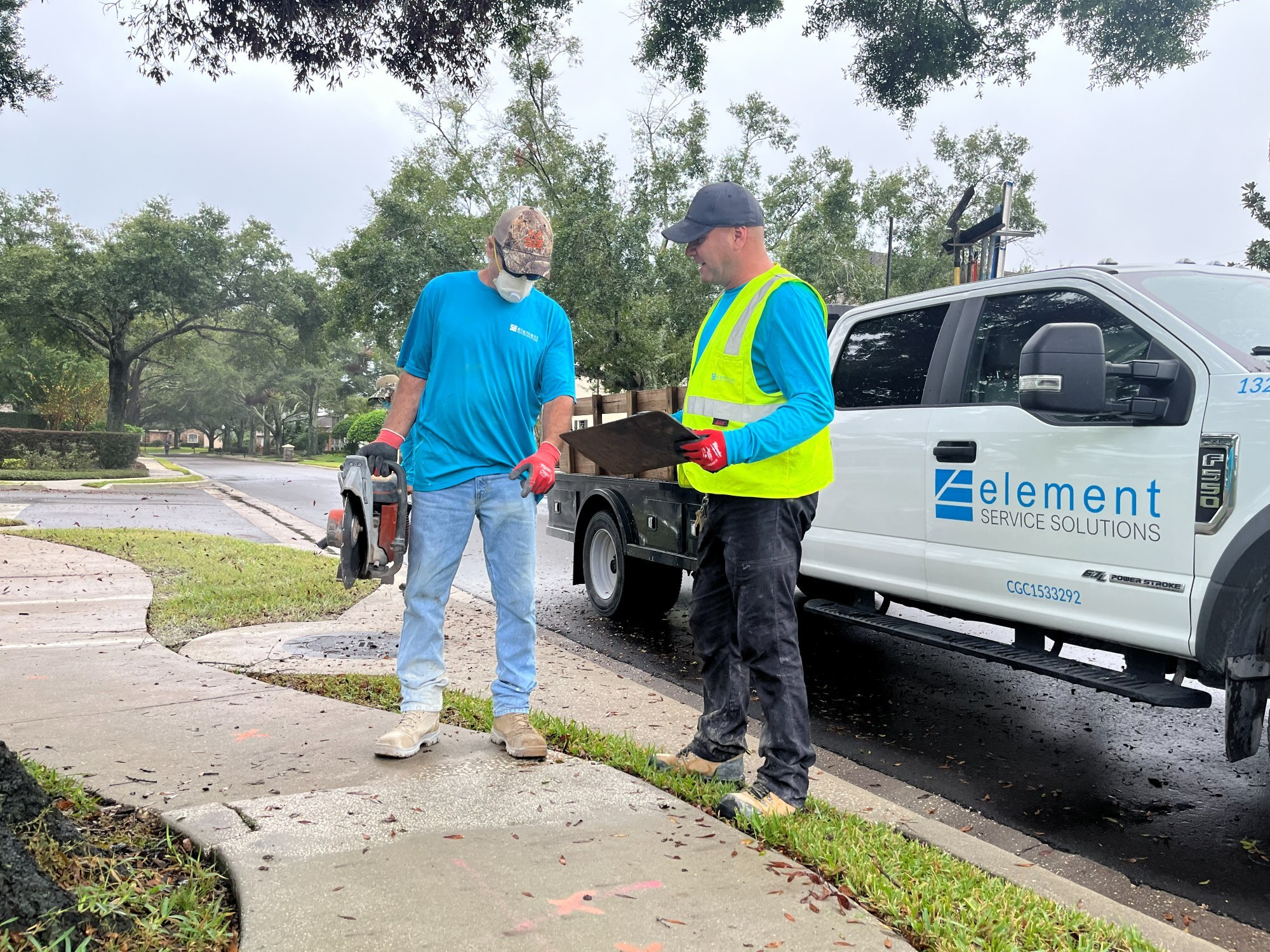
The crew shows up on day one, and the first section they close off is not the walkway by the main entry. It is a section around the side, one most residents will not notice for a day or two. Boards sometimes read this as the contractor stalling, saving the visible, high-traffic work for later while they warm up somewhere easy. That is rarely what is happening. A concrete crew that knows what it is doing starts with the section that costs the property the least while it is closed, and works toward the section that costs the most, so the highest-traffic area is closed for the shortest possible window.
That is a sequencing decision, and it is different from a method decision. Method is whether a section gets patched, resurfaced, or fully replaced, and that call belongs to a site inspection and belongs to Sidewalk Grinding vs. Replacement and Why Concrete Patches Fail, not to this article. Sequence is a separate question: once the method is decided for every section on the job, in what order does the work happen, and what does each order do to the people who live there while it is underway. This is a guide to that second question, because it is the one that determines whether a concrete project reads to residents as "the board handled this well" or "nobody thought this through."
Why sequence is an access plan, not just a work order
New concrete cannot take foot or vehicle traffic the moment the crew leaves. Fresh concrete needs a period to gain enough strength to carry weight without marking, cracking, or deforming, and that period runs from several days for light foot traffic up to roughly a week or more before it should see regular vehicle loading, depending on the mix, the weather, and the section's thickness. That means every pour is not a task with a start and an end. It is a closure with a start and an end, and the property has to function around it for the whole window, not just for the hours the crew is physically on site.
A contractor who treats a multi-section job as one undifferentiated scope, without a stated order and without stating what closes when, is handing the board a schedule with a finish date and nothing else useful. A contractor who has actually thought about sequencing can tell the board, before a single yard of concrete is poured, which door is unusable in which week, which drive aisle is one lane instead of two, and where residents should park in the meantime. That is the difference between a work order and an access plan, and only one of them lets a board tell residents anything specific before the trucks arrive.
What "closed" actually means, and why it is not the same for every section
Foot traffic versus vehicle traffic
A poured walkway reaches a point where it can carry someone walking across it well before it can carry a parked or turning vehicle. That gap matters on a property where a walkway and a drive aisle sit close together, because a section can sometimes reopen to residents on foot while it is still closed to golf carts, delivery trucks, or moving vans. A sequence plan that only tracks "open" and "closed" is missing a real distinction. Ask the contractor whether their schedule tracks foot access and vehicle access separately, because on some jobs that separation shortens the real inconvenience window by days.
Why a flat number of days does not cover every section
Cure time is affected by temperature, humidity, direct sun exposure, and the thickness of the section poured. A thin walkway section in warm, dry weather firms up faster than a thicker driveway apron poured during a stretch of cooler, wet days. A contractor who gives the board one blanket number for every section on the property, regardless of what each section is or when it was poured, is simplifying past the point of being useful. Ask for an approximate reopening window per section, not one number applied to the whole job, and build in the expectation that weather can push any individual section later.
Working backward from what the property actually needs to keep moving
The sequencing that produces the least disruption almost never starts with the biggest section or the section that is in the worst physical condition. It starts by mapping every access point the property depends on daily, then working out which pour section touches which access point, then ordering the work so no two critical access points are closed to residents at the same time if that can possibly be avoided.
Doors and building entries
A section of walkway directly in front of a building entry, especially one serving a stairwell shared by several units, is the highest-cost closure on the property because there is often no reasonable alternate route. If a building has a second entry, even a less convenient one, the sequence plan should route residents there while the primary entry's apron cures, rather than closing the only way in and out of a building for the better part of a week.
Parking and drive aisles
Losing a portion of a parking area or narrowing a drive aisle to one lane is disruptive but usually manageable if residents know about it in advance and know where to park instead. What is not manageable is losing parking without warning on the same day a resident gets home from work. Sequence planning should identify, before work starts, where displaced vehicles go for each phase, not just that some spaces will be unavailable at some point.
Trash and mail pickup windows
Waste collection and mail delivery run on fixed schedules the association does not control. A pour section that blocks a dumpster enclosure or a bank of mailboxes on a day collection is scheduled creates a problem that has nothing to do with the concrete and everything to do with timing. A contractor who asks about collection days before finalizing the sequence is planning around the property's actual operating rhythm. A contractor who does not ask is leaving that collision for the board to discover.
Emergency and service vehicle access
At every point in the sequence, at least one unobstructed path should exist for emergency vehicles to reach every building on the property, and that path should be confirmed with the contractor, not assumed. This is worth stating plainly in the pre-construction conversation and worth walking the property to verify once work begins, because a sequence that looks fine on paper can still leave a narrow section pinched between a closed pour and parked construction equipment.
Phasing so the property stays walkable
The general principle behind a well-built sequence is that no resident should ever be more than one reasonable detour away from a working door, a parking space, and a route out of the property. That usually means breaking a large concrete scope into phases small enough that only one section near any given building is closed at a time, even if that means the whole project runs slightly longer in calendar weeks than it would if every section were opened and poured simultaneously.
A board should ask directly whether the contractor is proposing to open multiple sections across the property at once or to move through it in a rolling sequence, section by section. The faster approach closes more of the property sooner but for a shorter overall span. The rolling approach keeps more of the property open at any given moment but stretches the total project timeline. Neither is automatically correct. The right answer depends on the property's layout, how much of the concrete inventory is being touched in this phase (see Concrete Inventory on Community Property for how to think about that inventory as a whole), and how much disruption the board is willing to accept in exchange for a shorter calendar.
What a rain day does to the sequence
Florida's wet season does not pause a concrete schedule so much as reorder it. A pour that gets rained out has to be rescheduled, which pushes every section behind it later. A section that was poured just before a storm may need extra time to reach the same strength a section poured in dry, warm conditions would reach in less time, because moisture and temperature both affect how quickly concrete gains strength. A contractor with a real sequence plan builds a buffer into the schedule for exactly this, and communicates a shift when it happens rather than letting the board discover a missed date on its own.
What a board should watch for is a schedule with no stated buffer at all, presented as though the calendar is fixed regardless of weather. During the months when afternoon storms are a near-daily possibility, a schedule that assumes every pour date holds is not a realistic schedule. Ask how the contractor handles a rain delay: do later sections simply slide, or does the whole sequence get reshuffled, and how will the board and residents be told when that happens.
Temporary routing and signage
A closed section without a marked alternate route just becomes a place where residents guess, and guessing near an active work zone is where minor incidents happen. A real sequence plan includes temporary signage naming which entrance or path is closed, an arrow or marked route to the nearest open alternative, and barricading substantial enough that it reads as a real closure rather than a suggestion. This should be part of what the board is checking for on site, not something assumed to be included because it seems obvious. A board walking the property mid-project should be able to find, at every closed section, a sign a resident unfamiliar with the project could follow without asking anyone.
Tools for the board
Sequencing worksheet: mapping pour areas to access
Before work begins, ask the contractor to fill out something close to this for every section on the job. If they cannot, that is useful information on its own.
| Pour area | What it blocks | Approx. closed to foot traffic | Approx. closed to vehicles | Alternate route provided |
|---|---|---|---|---|
| Example: north building entry apron | Primary entry, Building 3 | A few days | Not applicable, no vehicle path | Side entry via breezeway |
| Example: drive aisle section, east lot | One of two drive lanes | A few days | About a week | Single-lane flagged traffic |
| Example: dumpster enclosure apron | Trash collection access | A few days | About a week | Temporary staging area, confirmed with hauler |
Resident-notice template
A short, specific notice posted and distributed before each phase closes does more to prevent complaints than almost anything else in the project. A useful notice names the exact area, the exact dates it affects, and exactly where to go instead. A template a board can adapt for each phase:
- What is closing: name the specific entrance, walkway, or parking area, not "the concrete near the clubhouse."
- When: the start date and the approximate reopening date, stated as an estimate subject to weather.
- Why: one plain sentence, for example that the area is being repaired and needs time to cure before it can be used safely.
- What to do instead: the specific alternate entrance, route, or parking area for the duration.
- Who to contact: a single point of contact for questions, ideally the property manager or a named contact at the contractor.
Question bank for getting a real sequence plan out of a contractor
These are the questions that separate a contractor who has actually planned the job from one who has only priced it.
- Can you show me the order the sections will be poured in, not just a finish date?
- For each section, what is the earliest it will be open to foot traffic and what is the earliest it will be open to vehicles?
- Will more than one critical access point ever be closed to residents at the same time, and if so, which ones and for how long?
- What happens to the schedule if a pour gets rained out? Does everything after it shift, or does the sequence get reordered?
- Where will residents and their vehicles be routed during each phase, and has that route been checked against dumpster and mail pickup schedules?
- Who is responsible for posting and maintaining signage and barricades at each closed section for the duration it is closed?
- Is there ever a point in the project where emergency vehicle access to any building is not confirmed?
Common sequencing mistakes
| Mistake | What it costs the property |
|---|---|
| No stated order, only a finish date | Board cannot warn residents about anything specific until it is already happening |
| Multiple building entries closed at once | Residents in different buildings all lose primary access simultaneously instead of one at a time |
| No coordination with trash or mail schedule | Collection missed or rerouted with no notice, generating complaints unrelated to the concrete itself |
| Single blanket cure time for every section | Some sections reopen later than promised, or residents use a section before it is actually ready |
| No rain-day buffer built into the schedule | Every storm becomes a surprise delay instead of an expected adjustment |
| Closed sections with no signage or marked alternate route | Residents improvise a path near an active work zone |
Reading the schedule you are handed
A sequence plan should show up in writing, not just in a conversation with the crew leader on day one. If the schedule you receive from a contractor is thin on the details above, that is worth raising before the proposal goes to a vote, the same way a board should be checking scope language, exclusions, and payment terms line by line. How to Read a Contractor Proposal covers that broader review in detail, and a sequencing section belongs in that same document, not as a separate verbal promise made on site.
It is also worth confirming, before work starts, what the crew's own final check looks like once a phase wraps, since a section that "looks finished" from a distance is not always a section that matches the scope the board approved. The Crew Close-Out Walk covers what a contractor should be checking internally before calling a phase done, which matters just as much for a phased sequence as it does for a single job.
Finally, a contractor who can produce a real, section-by-section sequence plan without being pushed for one is usually telling you something about how they run every job, not just this one. That kind of planning discipline tends to show up elsewhere too, which is one more reason it belongs on the list of things a board checks before awarding work in the first place, alongside the broader vetting covered in What a Licence Check Does Not Tell You. You can review the concrete and general maintenance services Element Service Solutions provides to Central Florida communities as a reference point for what a sequencing conversation should cover.
Frequently asked questions
Why doesn't the contractor just close the whole property to traffic for the length of the project and finish faster?
Closing everything at once can shorten the calendar, but it maximizes disruption for every resident at the same time, and it usually is not necessary. A phased sequence takes longer overall but keeps most of the property functional throughout, which is the better trade for most occupied communities.
Can residents walk on new concrete sooner if they are careful?
No. Concrete that has not reached adequate strength can be marked, dented, or cracked by weight well before it looks wet or unfinished. A section should stay closed for the full window the contractor states, regardless of how dry or solid it appears.
What should the board do if the contractor cannot answer basic sequencing questions before the work starts?
Ask for the sequence plan in writing before signing, and treat a vague answer the same way you would treat a vague scope line elsewhere in the proposal. A contractor experienced with occupied properties should have this answer ready without much prompting.
How much notice should residents get before a section closes?
Enough that residents can plan around it, generally at least a few days before each phase begins, with a reminder closer to the closure date. Posting notice only on the day work starts leaves no time for anyone to adjust.
Does a rain delay in one phase always push the entire project back by the same amount?
Not necessarily. A well-managed schedule can sometimes absorb a short delay in one section without shifting every later phase, especially if the contractor has built in buffer time. A schedule with no buffer at all tends to pass every delay straight down the line.
Should the board require sequencing details in the written proposal, or is a verbal plan from the crew leader enough?
Get it in writing. A verbal plan can change without anyone updating the board, and a written sequence gives the board something specific to hold the contractor to if the actual work order differs from what was promised.
If your board is planning a concrete project and wants a sequence plan built around your property's actual access points before the work goes out to bid, Element Service Solutions offers a complimentary on-site inspection to walk the site, map the phasing, and help you ask the right questions of any contractor you are considering.