12 min read
When a Tree Root Is the Real Reason a Sidewalk Keeps Heaving
Gavin Sederopoulos : Published
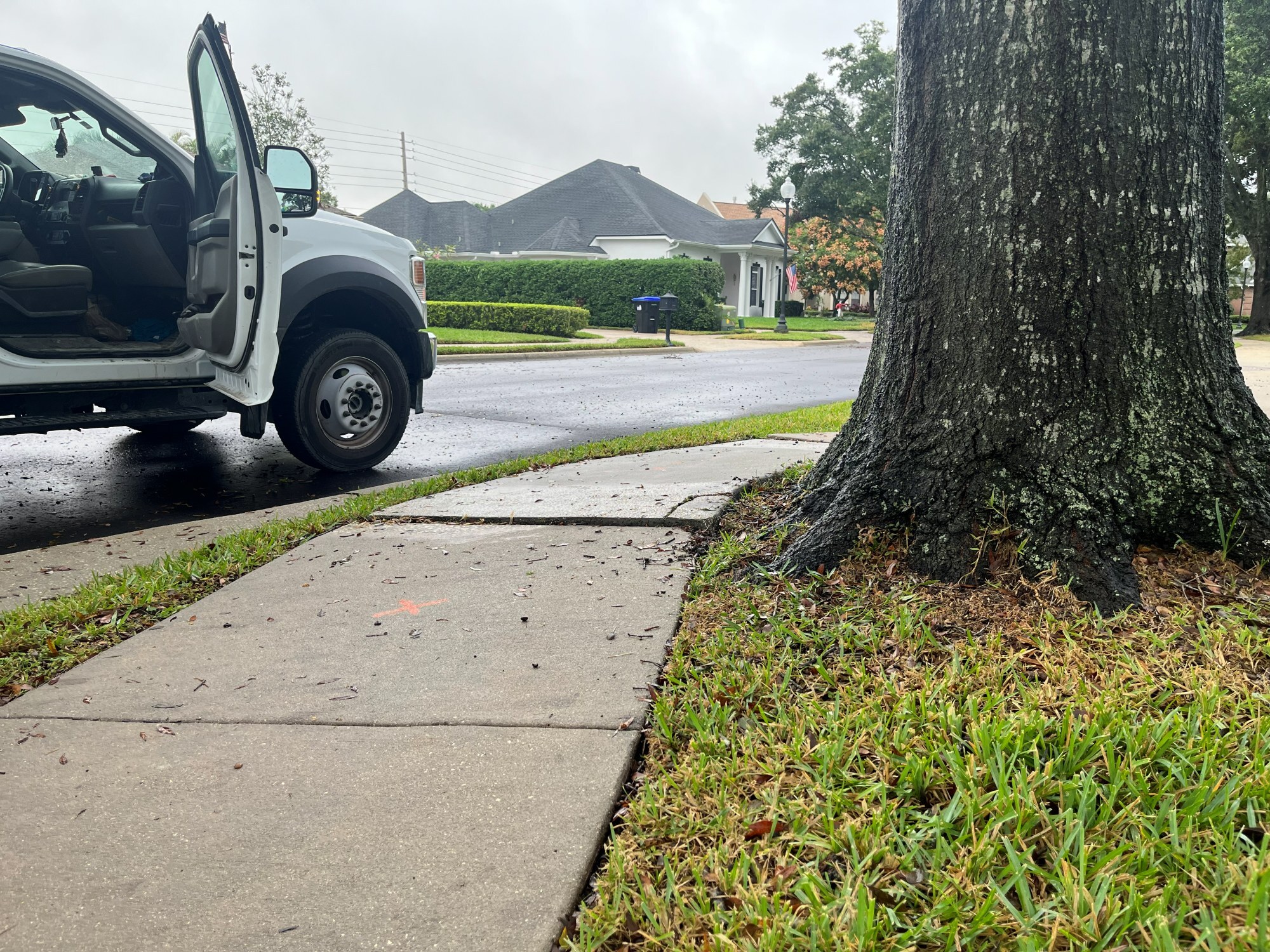
The patch is barely a year old and the crack is already back, running the same diagonal line through the new concrete that it ran through the old. Whoever poured the replacement slab did competent work. The problem is what is still underneath it.
A mature tree near a sidewalk or driveway does not stop growing because a contractor showed up with a saw and a load of ready-mix. Its root system keeps expanding on its own schedule, and a slab poured over or beside an active root will move again, usually within a season or two of the tree's next real growth push. Replacing the concrete without dealing with the root underneath it is not a repair. It resets the clock on a problem that was never addressed.
This is a guide to telling those two problems apart and choosing among the realistic ways to deal with a root that has decided a walk or a drive is in its way. It assumes a board already suspects, or has been told by a contractor, that a tree is involved. If your board is still building the record of exactly which panels are lifted, by how much, and where, How to Run a Trip-Hazard Survey covers that groundwork first, and the register it produces is exactly what a concrete contractor and an arborist will both want to see before either one gives an opinion.
Why fixing the slab alone does not fix anything
Concrete cracks and lifts for several reasons that have nothing to do with trees: a poorly compacted base, a slab poured too thin for the traffic it carries, expansive soil that swells and shrinks with moisture, or a joint that was never cut where it needed to be. All of those failures share one trait that a root-caused failure does not: once corrected, they stay corrected. A properly repaired base does not un-compact itself. A joint cut in the right place does not migrate.
A root is different because it is alive and it is still there after the slab is replaced. A structural root large enough to lift several inches of reinforced concrete is not a root a saw cut at the surface eliminates. The visible portion at the edge of the old slab is only the part that happened to intersect the walk. The rest of that root, and the tree feeding it, continues underneath the new concrete exactly as it did under the old. Left alone, it keeps doing what it was doing: thickening, and pushing whatever sits above it.
This is why a board can find itself repairing the same panel on a repeating cycle, paying each time for a slab that looks perfect on delivery day and starts telegraphing the same crack a year or two later. The panel was never the problem being solved. Recognizing that early, before a second or third repair cycle, is the single biggest decision in this whole category of repair.
Confirming the root is actually the cause
Not every panel near a tree that lifts is a root problem, and not every root problem announces itself the same way settlement or base failure does. Before a board commits to a root-focused repair plan, it is worth confirming the diagnosis rather than assuming it from proximity alone.
Signs that point to a root
A root-caused lift tends to look and behave differently from a settlement-caused sink, and the difference is usually visible if someone looks for it rather than just at the crack.
| Observation | More consistent with a root | More consistent with base failure or settlement |
|---|---|---|
| Direction of movement | Panel is pushed upward, often unevenly, with one edge riding higher than the rest | Panel has sunk or tilted downward, sometimes pooling water |
| Pattern across panels | A line of panels rises consistently along a path radiating out from the trunk | Movement is isolated to one panel or scattered with no relationship to a nearby tree |
| Visible evidence at the edge | A root is visible or can be felt with a probe at the slab edge or in the adjacent soil | No root is visible; soil below the edge is loose, washed out, or clearly disturbed |
| Distance from a mature tree | Damage sits inside or near the tree's canopy spread | Damage is well outside any canopy, or there is no mature tree nearby at all |
| Timing relative to any past repair | The same panel or joint has failed again within a season or two of a prior repair | This is the panel's first documented failure |
A simple sequence for checking
A board does not need to hire two separate consultants just to get a first read. A short, low-cost confirmation sequence, run by whichever contractor or arborist is already on site, usually settles the question before either trade quotes a fix.
- Note which panels are affected and how they relate to the nearest tree, using the register from a trip-hazard survey if one exists.
- Probe the soil at the lifted edge with a hand tool rather than guessing from the surface. A shallow root is often within a few inches of grade.
- Check whether the lift follows a line running away from the trunk, rather than sitting in an isolated spot with no relationship to any tree.
- Ask whether the site has expansive or historically unstable soil, which changes the read on a lift that is not clearly tied to a root.
- If the answer is still unclear after a visual check, bring in an arborist to confirm before any concrete work is scoped, not after.
Getting this sequencing wrong in the other direction is just as costly. A board that assumes every lift near a tree is root-caused can end up paying for root pruning that never needed to happen, while the actual cause, a failed base or a bad original pour, goes untouched and fails again anyway. If the survey and probe rule a root out, the repair decision becomes the more conventional question of grinding down the lip versus full replacement, which is covered on its own in Sidewalk Grinding vs. Replacement rather than repeated here.
The realistic options and what each one actually solves
Once a root is confirmed as the cause, a board has roughly five paths available, and none of them is free of trade-offs. Some are reversible and modest. Others are not reversible at all. The honest answer for any given tree usually depends on the tree's health, its size, its species, its value to the property's shade and appearance, and how close the conflict sits to the trunk.
| Option | What it preserves | What it risks | What it does not solve |
|---|---|---|---|
| Root pruning by a qualified arborist | The tree, in most cases, if only a limited portion of the root system is cut | Tree stability and health if too much root mass is removed at once, or if the wrong roots are cut | Regrowth. Pruned roots often need to be revisited on a recurring cycle, not treated as a one-time fix |
| Root barrier installed at the new slab | The tree, and the new concrete, by redirecting future root growth away from the repaired area | Effectiveness if installed too shallow, too short, or on the wrong side of an already-established root | Roots that have already grown past where the barrier would sit. A barrier manages future growth, not existing damage |
| Reroute or redesign the walk around the tree | The tree fully, with no cutting required | Straight-line convenience; a rerouted path may add distance or change how the area reads visually | Nothing, if the reroute clears the root zone entirely. This is the option with the fewest downstream surprises |
| Replace the slab with a different detail spanning the root zone | The tree, using a structural approach designed to bridge over or work around the root rather than fight it | Complexity of design and coordination between trades; not every contractor offers this as a standard approach | Future root growth elsewhere along the same path unless the detail accounts for it |
| Remove the tree | The concrete, permanently, once the stump and major root mass are addressed | Canopy, shade, and the visual and property value a mature tree provides; this is not reversible | The existing root mass immediately. Large roots can take a long time to break down even after the tree above them is gone |
Read that table with one thing in mind: the first four options all keep the tree, and the fifth does not. A board that reaches for removal as the first conversation, because it sounds like the cleanest fix, is usually skipping past options that would have solved the problem with far less lost. Removal belongs at the end of the list, considered honestly rather than avoided reflexively, not defaulted to because it is the option that sounds most final.
Being honest about cost and permanence without a number attached
None of these options are simple, and it is worth saying that plainly rather than letting a board assume the cheapest-sounding one is also the easiest. Root pruning is rarely a single visit; a tree that pushed a slab once will likely need its roots checked again on a recurring cycle for as long as it remains in that spot, a recurring line item to plan around, not a one-time job. A root barrier only works if installed correctly the first time, since a board rarely learns it was too shallow until the next lift appears years later. Rerouting a path sounds simple until the property's layout or a drainage grade makes the obvious detour impossible. And removal is the one choice here that cannot be undone. A mature tree took years to reach the size that makes it a problem, and a replacement will not provide the same shade or presence for a very long time, if the board even has room to plant one in the same spot at all.
Coordinating an arborist and a concrete contractor so neither one undoes the other's work
The most common way this kind of project goes wrong is not a bad decision. It is a sequencing failure between two trades that never actually talked to each other. A concrete crew that cuts a large structural root without an arborist's sign-off can destabilize or kill a tree that was otherwise healthy. An arborist who prunes roots without knowing where the new slab and its base will sit can leave the concrete crew with nothing solid to build on. Each trade is competent in its own scope and can still produce a bad outcome if it works in isolation.
Who decides what
| Decision | Who should make the call | Why |
|---|---|---|
| Whether a root can be cut safely, and how much of it | The arborist | Cutting too much root mass at once, or cutting a root close to the trunk, can compromise the tree's stability or long-term health in ways a concrete contractor is not trained to judge |
| Where the new slab, barrier, or reroute is physically positioned | The concrete contractor, working from the arborist's root map | The contractor knows what base and drainage conditions the new work needs; the arborist knows which zones near the trunk cannot be disturbed at all |
| Timing of the two scopes of work | Both, agreed in advance | Root work generally needs to happen before concrete work begins, and the tree may need a recovery period between the two |
| Whether removal is warranted | The arborist's assessment, reviewed by the board | This is a property decision with a permanent outcome; it should not be made unilaterally by whichever trade is on site that day |
A board does not need to manage this coordination directly, but it should ask for it explicitly rather than assuming two separately hired vendors will talk to each other on their own. The simplest way to get it is to require, in writing, that any structural root cutting have an arborist's sign-off before it happens, and that the concrete contractor's plan be shared with the arborist before either trade starts work. A contractor that already coordinates arborists, concrete crews, and general grounds work as part of how it operates removes one hand-off the board would otherwise have to manage itself; see Element Service Solutions for the range of trades a single contractor can bring to a job like this. If your community is weighing whether to keep hardscape, landscape, and general concrete work with separate specialists or move it under fewer vendors, the due diligence for that decision, including how to verify a company can genuinely coordinate across trades, is covered in Before You Consolidate to One Contractor.
Building the record before requesting proposals
A board that walks into a bid conversation with a clear record gets more useful, more comparable answers from every contractor and arborist it talks to. A board that walks in with only a general complaint about a "bumpy sidewalk near the big oak" gets vague answers back, because there is nothing specific to respond to.
| What to gather | Why it matters |
|---|---|
| Photos of each affected panel, including a wide shot showing the tree's position | Lets a contractor or arborist see the relationship between the damage and the tree without a site visit being the first look |
| Panel identifiers or a simple site sketch, tied to a trip-hazard register if one exists | Makes the scope specific and repeatable rather than a general area description |
| Rough estimate of the tree's age or how long it has been at that size | A young, fast-growing tree and an old, established one carry very different long-term root trajectories |
| Any prior repair history at the same location, with approximate dates | A panel that failed once before and is failing again on a short cycle is strong evidence of an unaddressed root, not a coincidence |
| Notes on how close the affected panel sits to the trunk versus to the edge of the canopy | Proximity to the trunk changes what pruning options are even safe to consider |
Prioritizing when more than one tree is involved
Most communities with mature landscaping do not have just one tree-versus-concrete conflict. They have several, in different stages, and a board with a limited number of projects it can approve in a given cycle needs a way to decide which ones move first.
| Situation | Priority | Reasoning |
|---|---|---|
| Significant lift on a primary walking route or near an entrance | High | Trip risk on a heavily traveled path outweighs a similar lift on a rarely used side path |
| Minor lift, well away from foot traffic, not worsening between inspections | Low | Monitoring on a normal inspection cycle is a reasonable answer; not every lift needs an immediate project |
| Repeat failure at a location already repaired once without addressing the root | High | A second failure confirms the root was never actually dealt with, and a third repair without a root plan will likely fail the same way |
| Large, healthy, high-value shade tree near a comparatively minor slab issue | Favor root-preserving options first | The tree's value to the property argues for pruning, a barrier, or a reroute before removal is even discussed |
| Declining or already-damaged tree combined with significant, recurring concrete failure | Removal becomes a reasonable option to evaluate | A tree that is already in poor condition has less to lose from root work, and may not be a candidate for long-term preservation regardless of the concrete issue |
Common mistakes boards make with this kind of repair
| Mistake | What to do instead |
|---|---|
| Approving a slab replacement without ever asking whether a tree is involved | Ask the contractor directly whether the lift correlates with a nearby tree before scoping the repair as pure concrete work |
| Hiring a concrete contractor and an arborist separately with no requirement that they coordinate | Require, in the award, that any root cutting be reviewed by the arborist before the concrete crew proceeds |
| Treating one round of root pruning as a permanent fix | Budget it as a recurring item for as long as the tree stays in that location, and schedule a follow-up inspection rather than assuming it is finished |
| Jumping straight to removal because it sounds like the most final answer | Walk the full options table first, and reserve removal for trees that are already declining or where every preserving option has been genuinely ruled out |
| Replacing the slab with the same detail that already failed once | Ask whether a different detail, a reroute, or a barrier makes more sense than repeating the exact repair that did not hold |
A note on species and where problems tend to concentrate
Not every tree pushes concrete the same way. Fast-growing shade species planted close to a walk or drive tend to send roots out along the surface rather than straight down, which is exactly the growth pattern that lifts flatwork. A tree of that type planted within a few feet of a path is worth a closer look even before damage appears, simply because the growth habit makes a future conflict more likely than a deeper-rooted species planted farther back. This is a reason to plan ahead on new landscaping decisions, not a reason to assume every existing tree on the property is a problem. Most are not.
Tree-versus-hardscape conflicts rarely sit in isolation from the rest of a property's maintenance calendar. Root work, concrete work, and any nearby landscaping disturbance need to happen in a sensible order relative to each other and to the rest of what the board has scheduled for the year, the kind of cross-project sequencing covered in The Order of a Year of Projects. A board that approves the concrete fix in isolation, without checking it against a scheduled drainage project nearby, can end up redoing access planning twice for the same corner of the property. If your board is also sequencing this repair around resident access, Sequencing a Concrete Repair Around Access covers how a pour schedule interacts with doors, parking, and foot traffic once the root question is settled.
Frequently asked questions
How do we know if a lifted sidewalk panel is a root problem or just old concrete?
Look at the pattern first. A root cause usually shows up as a line of panels rising along a path radiating from a nearby tree, sometimes with a visible or probe-able root at the edge. Isolated sinking, tilting toward a low point, or damage with no mature tree anywhere nearby points more toward base failure or settlement instead. When it is genuinely unclear, a short site visit from an arborist before any concrete work is scoped will usually settle it.
Can a slab just be poured thicker or reinforced more heavily to resist a root instead of dealing with the tree at all?
A thicker or more heavily reinforced slab can extend how long it takes a given root to cause visible damage, but it does not stop the root from growing. A structural detail designed specifically to span or bridge the root zone is a genuine option and is different from simply pouring more concrete over the same conflict; the difference is in the engineering, not the thickness.
Will pruning a root hurt or kill the tree?
It can, if too much root mass is removed at once or if the wrong roots, particularly large structural roots close to the trunk, are cut. This is exactly why root pruning should be planned and performed with an arborist involved rather than left entirely to a concrete crew clearing its own path.
How often does a pruned root need to be checked again?
There is no single fixed schedule; it depends on the tree, its growth rate, and how much root was removed. What matters is that a board should not treat one round of pruning as permanent. Building in a follow-up inspection, and expecting that some trees will need periodic revisiting for as long as they remain in that spot, is a more realistic plan than assuming the issue is closed.
Is removing the tree ever the right call?
Sometimes, particularly for a tree that is already declining, poorly positioned relative to its surroundings, or where root pruning, barriers, and rerouting have all been genuinely evaluated and ruled out. It is not the right first conversation for a healthy, valuable shade tree with a manageable amount of root conflict, because that decision cannot be undone once the tree is gone.
Should the board get a second opinion before approving removal?
Yes. Removal is the one option on this list with no way back, so it is worth a second, independent look, ideally from an arborist who was not involved in scoping the concrete repair, before a board votes on it.
If your board is looking at a lifted walk or drive near a mature tree and wants an honest read on whether the tree, the base, or the original pour is actually driving the damage, Element Service Solutions offers a complimentary on-site inspection to walk the property and lay out the realistic options before any work is scoped.