10 min read
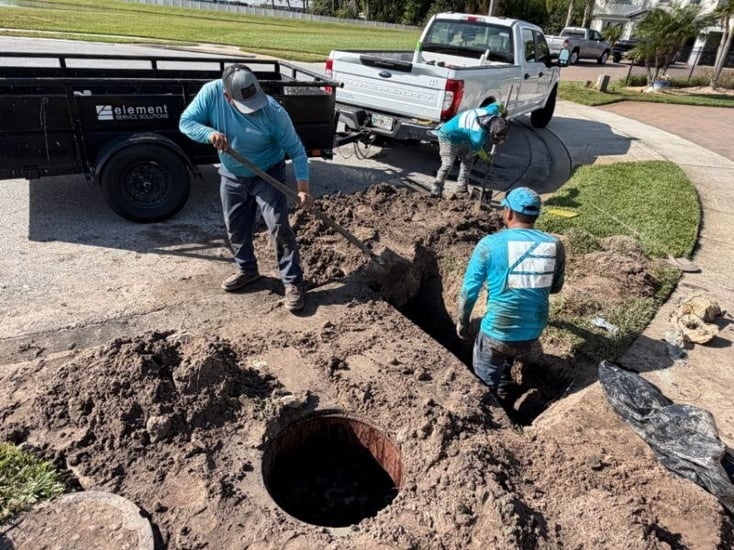
Quick answer: A bare patch that keeps returning in the same spot is usually a drainage problem showing up as a landscaping symptom. That spot is a discharge point, where a pipe or swale releases concentrated stormwater, so sod cannot hold there. Replacing sod again will not last. The fix starts with the discharge point and the channel below it, using materials that hold when ordinary vegetation does not.
Updated November 2026 by Gavin Sederopoulos, Vice President of Sales, Element Service Solutions
There is a spot on almost every property with a drainage system where the grass just will not stay. Sod goes down, looks fine for a while, and then a bare patch of soil reappears in the exact same place after the next hard rain. The landscaping crew gets called back. New sod goes down again. Same result a few storms later. At some point someone notices the pattern: this is not happening randomly across the property. It is happening at one specific spot, right where a pipe or a swale actually discharges water off the site.
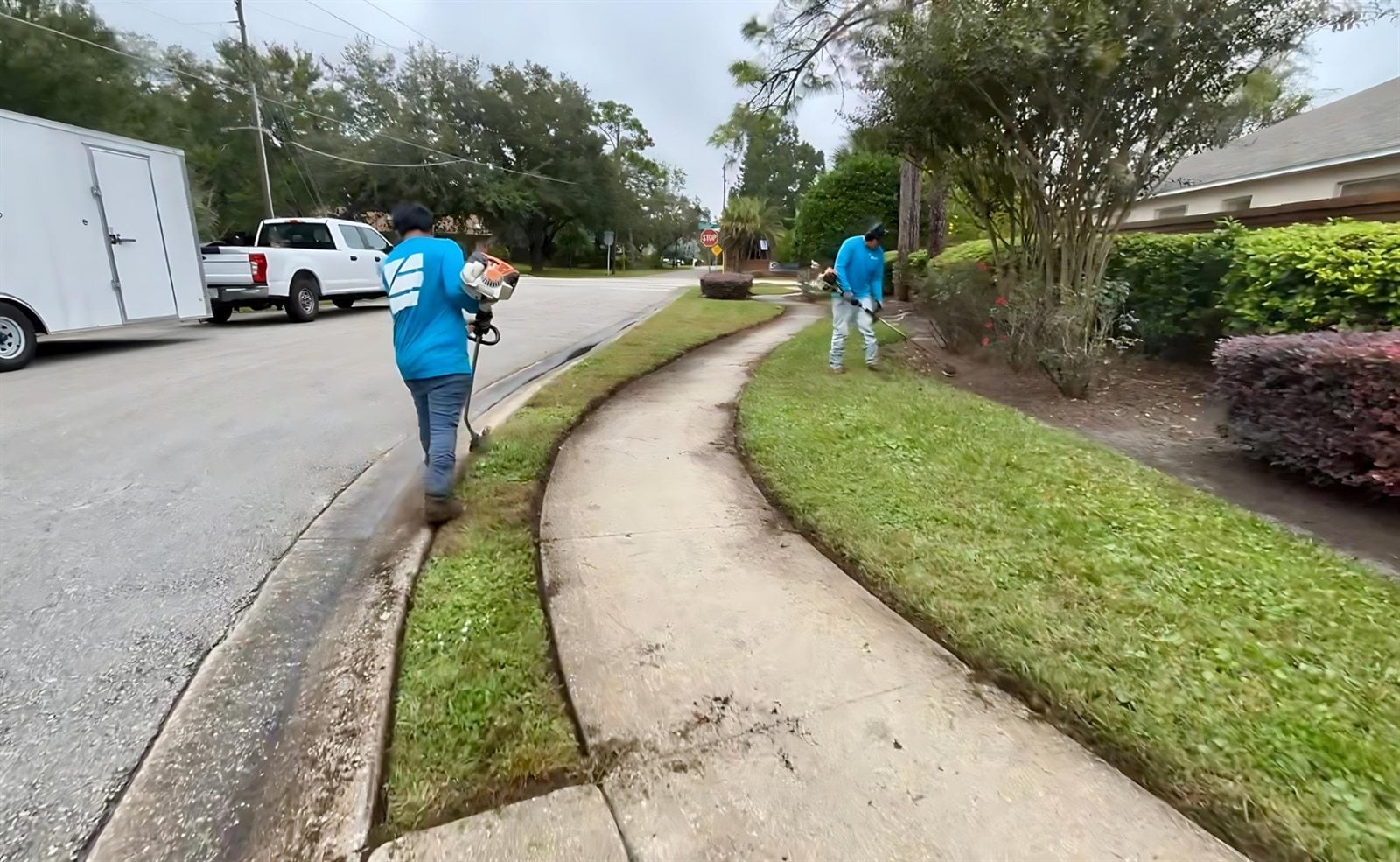
That location is not a landscaping problem. It is a drainage problem wearing a landscaping symptom, and treating it as the former is why the fix never holds. This is about that specific spot, the discharge point where stormwater leaves your property, why sod cannot survive there the way it survives everywhere else, what the ground and the channel below it are actually telling you, and what holds when regular vegetation does not.
What makes a discharge point different from the rest of the property
Everywhere else water moves across a Central Florida property, it is spread out. Rain falls on a lawn, sheets across a broad area, and soaks in or moves slowly toward a low point. A discharge point is the opposite condition. It is where all of that water, collected from a pipe run, a swale, or a larger drainage system across the property, arrives concentrated into one narrow location and leaves all at once. Water that was distributed across an acre a few minutes earlier is now moving through a space you could stand in.
That concentration is the entire difference. A general lawn area experiences water as rainfall. A discharge point experiences water as flow, moving with force in one direction, repeatedly, every time it storms. Turf, soil, and root systems are built to handle the first condition. They are not built to handle the second, no matter how well established the grass is anywhere else on the property.
Why sod cannot hold this specific spot
General sod failure on a Central Florida property usually traces back to shade, compaction, the wrong cultivar for the site, irrigation problems, or heavy foot traffic wearing grass down faster than it can recover. Those causes, and how to fix them, are covered in Why Resodding Keeps Failing. None of that is what is happening at a discharge point, and re-sodding with a better cultivar or fixing the irrigation schedule will not solve it, because the cause here is different in kind, not just degree.
| Ordinary lawn area | A drainage discharge point |
|---|---|
| Water arrives as rainfall, distributed across a wide area | Water arrives concentrated, all at once, from everything the system collected upstream |
| Root systems have time between rain events to reestablish and hold soil | Repeated flow events, storm after storm, do not give roots a real recovery window |
| Grass failure usually points to a growing-condition problem: shade, compaction, irrigation, cultivar | Grass failure points to a flow problem: the volume and speed of water simply exceeds what any turf root mass can resist |
| A better cultivar or improved care typically fixes the problem | A better cultivar changes nothing, because the mechanism of failure is force, not growing conditions |
This is why a discharge point can keep failing sod after sod even on a property where the landscaping contractor is doing everything right everywhere else. The problem was never the grass. It is the volume and velocity of water hitting one small area, over and over, faster than any planted root system regenerates.
Reading what the ground is telling you
The condition of the soil and vegetation at a discharge point is a reasonably reliable record of how the flow there is behaving, if you know what to look for. None of this requires special equipment. It requires walking to the actual point of discharge, not just glancing at the general area from a distance, and looking closely at what the ground has done.
| What you see | What it indicates |
|---|---|
| Grass thinner here than elsewhere, but ground still level and no exposed soil | Flow is stressing vegetation but has not yet started moving soil. Early stage, worth watching |
| A bare soil patch beyond the discharge point, ground still roughly level | Vegetation has lost the fight, but the soil beneath is not yet actively eroding away |
| Visible rills or a shallow channel cut into the bare soil | Flow is now concentrated enough to move soil, not just prevent grass from growing. Active erosion |
| Undercutting beneath a pipe end or at the base of a headwall | Flow is removing the soil that supports a structure. This is a structural concern, not a cosmetic one |
| A fan or delta of deposited soil below the discharge point | Material is being carried and dropped somewhere, which confirms real volume and energy in the flow, and shows where the lost soil is actually going |
| The bare or eroded area growing larger or shifting position after each storm | The erosion point is migrating, not static. Left alone, it keeps expanding rather than settling into a stable condition |
The last row matters more than it looks. A stable, unchanging bare patch and a bare patch that is visibly larger than it was three storms ago are different problems with different urgency, even though both might look similar on a single visit. Comparing conditions over time, not just checking the box that a bare patch exists, is what actually tells you whether this needs attention now or can be monitored a while longer.
The channel below the outfall matters as much as the outfall itself
It is easy to focus entirely on the discharge point and miss that the problem often continues downstream of it, in the channel or swale that carries water away after it leaves the pipe or structure. Erosion at a discharge point rarely stays contained to the exact spot where water first hits the ground. The force that eroded the discharge point keeps carrying downstream, and the channel below it takes the same punishment, often with less attention paid to it because it is further from where anyone naturally looks.
Walk the receiving channel, not just the discharge point, and look for the same signs: bare soil, rilling, undercutting along the banks, and any sign that the channel's shape has changed from a stable, gradual profile into something steeper or more irregular than it should be. A discharge point that has been repaired without addressing a damaged channel below it will often fail again, because the water leaving the repaired point still has nowhere stable to go.
What actually holds at a discharge point
Once it is clear that ordinary turf will not survive a given discharge point, the question becomes what will. There is no single universal fix. What works depends on how much force the water is arriving with, how the channel below the point is behaving, and whether any structure at the discharge point itself, like a headwall, is sound or already compromised. The general categories of approach are described here at a conceptual level. The right combination for a specific location is a site-specific judgment, not something to guess at from this list.
| Approach | What it does | Where it fits | What it does not solve on its own |
|---|---|---|---|
| Energy dissipation at the discharge point | Breaks up and slows the force of water before it contacts bare soil | Points where a concentrated, high-velocity jet of flow is the primary problem | A channel below the point that is already damaged or undercut |
| Armouring the discharge area | Physically resists the force of moving water with material that does not wash away the way turf and topsoil do | Areas where flow is forceful but not constant, and where the area is not expected to read as ordinary lawn | Erosion below where the armouring ends, if the transition back to unprotected ground is not planned for |
| Regrading the receiving channel | Restores a stable shape and a gradual, even path for water to move through instead of repeatedly cutting a new one | Channels that have already been reshaped by repeated erosion events, not just the point where water enters them | Anything above it. This step assumes the discharge point and the grade above it are already sound |
| Headwall or structure repair | Restores the physical support a pipe or box structure depends on, correcting the actual cause of undermining | Locations where undercutting or a visibly compromised structure is already present | Erosion in the open channel below the structure, which needs its own attention |
Notice that these approaches are often used together rather than as alternatives to each other. A discharge point with a compromised headwall and a badly cut channel below it typically needs structure repair and channel regrading in the same effort, not one instead of the other. Treating only the most visible symptom, usually the bare patch itself, while leaving an undercut structure or a damaged channel unaddressed is how a repair that looked complete fails again within a season.
How urgent is this, really
Not every discharge point erosion problem needs an immediate response, and not every one can wait for a routine cycle either. A simple way to sort what you are looking at helps set the right pace.
| Level | What you see | What to do |
|---|---|---|
| Watch | Thin grass at the discharge point, no bare soil yet | Note the condition and revisit after the next significant storm |
| Address soon | Bare soil, shallow rilling, ground otherwise stable, no undercutting visible | Schedule a repair before the next wet-season storm cycle turns it into something structural |
| Act now | Undercutting at a pipe end or headwall, or soil actively migrating into the channel below | Bring in someone who can assess the structure, not just a landscaping crew, without waiting for a routine walk |
| Emergency | A structure visibly failing or exposed, or erosion beginning to undermine adjacent hardscape or a nearby structure's footing | Address immediately. This has moved past a maintenance item |
Inspection checklist for the discharge point and the channel below it
- Confirm the exact point where the pipe or swale actually discharges, not just the general area that looks bare from a distance.
- Examine the ground immediately at the discharge point for bare soil, rilling, or a channel cut into what should be a stable surface.
- Check beneath and around any pipe end or headwall for undercutting or exposed footing.
- Walk the receiving channel downstream of the discharge point, not just the discharge point itself, since the damage often continues past where anyone naturally looks.
- Note where eroded material has come to rest, whether as a fan or delta below the point, and whether it is affecting anything else nearby.
- Photograph the location from the same fixed reference point on each visit so change over time is actually visible, rather than relying on memory.
- Log the date of each observation and, where known, the storm event associated with it, so a pattern across a season becomes visible rather than a series of disconnected complaints.
Why the landscaper keeps getting the call for a drainage problem
The bare patch is visible. The undercut headwall thirty feet away, half hidden by vegetation, usually is not. So the call goes to whoever handles the visible symptom, which is almost always the landscaping contractor, and the landscaping contractor does the only thing within their scope: replace the sod. That is not a failure on their part. Regrading a channel or repairing a headwall is not landscaping work, and most landscaping contracts were never written to include it.
The pattern breaks when someone asks a different question at the site visit: not "why won't the grass grow here" but "what is actually happening to the water at this exact spot." That question routes the problem to whoever can answer it, which is a contractor equipped to look at flow, grade, and structure condition together, not just plant material. Until that question gets asked, the same sod order repeats every season with the same result.
Who to call and when
| Situation | Who to bring in |
|---|---|
| Thin grass, no bare soil, no structural concern | Routine landscaping maintenance |
| Bare soil or shallow erosion at the discharge point, structure appears intact | A contractor experienced in drainage and erosion repair, not landscaping alone |
| Undercutting, an exposed or compromised structure, or a migrating channel | A drainage contractor, and if the structure's soundness is in question, someone qualified to assess it before repair work begins |
| The same failure recurring after a repair was already attempted | A fresh diagnosis of the approach used the first time, rather than repeating the same fix a second time |
This inspection and triage work pairs naturally with a broader post-storm routine. If your board already runs a structured walk after significant rain events, the discharge point and the channel below it belong on that route; see The Post-Storm Drainage Walk for how to build that walk and log what it finds across a season. And because a gutter system feeding into site drainage can compound what is happening at a discharge point downstream, a roof edge that has lost pitch after wind load is worth ruling out as a contributing source; see What a Storm Does to a Gutter Run.
Getting the sequence right when repair work finally happens
Once a discharge point repair is scheduled, the order it happens in relative to any nearby landscaping work matters. Regrading a channel or repairing a structure and then immediately laying new sod over freshly disturbed ground, without giving the drainage fix time to prove itself through at least one real storm, risks tearing up the new planting the moment the fix is tested. Drainage correction belongs before the final landscaping pass, not the other way around, which is the same general principle behind sequencing any set of related projects across a property. See Sequencing Community Projects Annually for how that dependency logic applies across a full year of planned work, not just this one repair.
Common mistakes
- Re-sodding without diagnosing the flow. New sod at a discharge point with unaddressed concentrated flow is a repeat order waiting to happen, not a fix.
- Only inspecting the discharge point, not the channel below it. Erosion frequently continues downstream of where anyone naturally looks first.
- Treating a structural undercutting issue as a landscaping call. A landscaping crew can replant grass. They are not the right party to assess or repair a compromised headwall or pipe support.
- Landscaping the area immediately after a drainage repair. Give the fix a real storm or two to prove itself before finishing the surface over it.
- Assuming a bare patch that has not grown is the same problem as one that has. Comparing conditions across visits, not a single look, is what actually shows whether this is stable or actively worsening.
Element Service Solutions handles drainage outfall and erosion repair for HOA, condo and apartment communities across Seminole, Orange, Lake and Volusia counties, including Orlando, Apopka, Lake Mary, Oviedo, Tavares and Ormond Beach. If your board needs a lasting fix for a bare patch at a discharge point, our team can walk the property with you and scope the work. Learn more about our drainage and erosion solutions.
Frequently asked questions
Is a bare patch at a drainage discharge point always a sign of a serious problem?
Not always. A stable bare patch that is not growing, with no undercutting and no rilling, may simply reflect a spot where turf was never going to hold and can be managed with a more resistant ground cover rather than an urgent repair. The distinction is whether the condition is static or actively worsening across successive storms.
Will a more durable grass or ground cover fix a discharge point on its own?
Rarely, if the underlying flow problem is concentrated, forceful water. A hardier planting can help at the margins, but if the volume and velocity of flow exceeds what any root system can resist, the planting choice is not the limiting factor. The flow itself needs to be addressed.
How is this different from the general reasons sod fails on a property?
General sod failure usually traces to growing conditions: shade, compaction, irrigation, or the wrong cultivar for the site. A discharge point fails for a different reason entirely, concentrated flow that exceeds what any turf root mass can hold, regardless of how well the grass is cared for.
Should this be handled by the same crew that mows the property?
Not once bare soil, rilling, or any sign of undercutting is present. A landscaping crew can maintain planted areas, but diagnosing and repairing an active erosion or structural issue at a discharge point calls for a contractor experienced specifically in drainage and erosion work.
How often should a discharge point be checked?
At minimum, after any significant storm, as part of a broader post-storm drainage walk. A location that has been stable for a while can still change quickly after one unusually hard rain event, so a periodic look even in a quiet season is worth keeping on the calendar.
Can this wait until the next budget cycle if it does not look urgent right now?
If the condition is genuinely stable, watching it through a budget cycle is reasonable. If there is any undercutting, exposed structure, or a bare area that is visibly larger than it was a season ago, waiting allows the erosion point to keep migrating, which usually turns a smaller repair into a larger one by the time it is finally addressed.
If a spot on your property keeps losing sod after every storm, Element Service Solutions offers a complimentary on-site inspection to walk the discharge point and the channel below it, confirm what is actually driving the erosion, and lay out what it will take to make the fix hold. Visit elementbiz.com to get started.